A corrosion resistant linear guide is a linear guide whose materials withstand moisture, condensation and regular cleaning without rusting. Such guides are also called stainless steel linear guides or rustproof linear guides.
Why corrosion is a problem for linear guides
In a linear guide, running rollers or balls roll under load on hardened raceways. Even light rust on these raceways makes the motion rough and noisy, increases wear and shortens service life. Conventional raceways made of rolling bearing steel or spring steel are susceptible as soon as water, humid air or cleaning agents reach them.
Stainless steel and corrosion resistance: what matters
Not every high grade steel is stainless. What protects steel against corrosion is a sufficient chromium content, which forms a protective passive layer on the surface. Anyone looking for a linear guide for humid environments should therefore ask specifically for stainless materials at the points where they matter.
How corrosion resistant linear guides can be designed
Manufacturers take different approaches:
- Rail and carriage made entirely of stainless steel: very resistant, but heavy and comparatively expensive.
- Coated steel guides: a surface layer protects the base material, but depending on the process it can wear on the raceways.
- Material combination: a lightweight, corrosion resistant base body and stainless materials exactly where rolling contact takes place.
The Franke approach: aluminium with stainless steel raceways
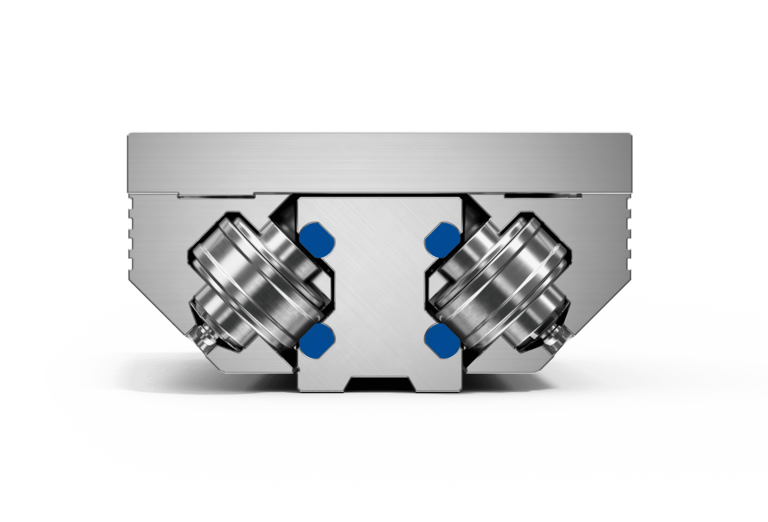
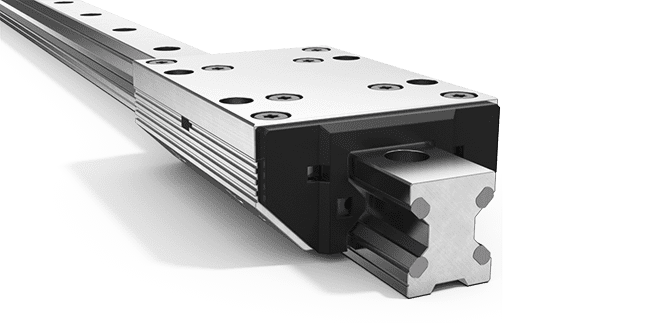
Franke linear guides work on the principle of inserted raceways: steel raceways lie in the aluminium rail body, and the running rollers of the carriage roll on them. In the corrosion resistant types, exactly these functional parts are made of stainless steel:
- Rail body, carriage plate and roller shoes: aluminium, anodized
- Raceways: stainless steel
- Running rollers: stainless rolling bearing steel
The anodized layer protects the aluminium, the stainless materials protect the raceways and running rollers. The guide stays light and is still insensitive to moisture.
Typical applications
- Machines that are regularly cleaned with water and cleaning agents, for example in food processing, packaging technology and beverage bottling
- Medical technology and laboratory automation, where devices are frequently disinfected
- Systems with high humidity or condensation, for instance during temperature changes
- Protected outdoor applications where moisture reaches the guide
Limits and what to watch out for
Corrosion resistant does not mean resistant to everything. Anodized aluminium tolerates neutral and mildly acidic or alkaline media well, but strongly alkaline or strongly acidic cleaning agents attack the anodized layer. For salt water, aggressive chemicals or special hygiene requirements, materials, lubricant and cleaning agents should be matched case by case. The Franke types are designed for operating temperatures from −20 °C to +80 °C.
Corrosion resistant linear guides from Franke
Franke offers two corrosion resistant roller guides, each as profile rail with carriage and as pair of profile rails with pair of roller shoes:
- Type FDC: running rollers with needle bearings, particularly quiet and smooth running. FDC profile rail with carriage | FDC pair of profile rails with pair of roller shoes
- Type FDG: running rollers with ball bearings, the economical version. FDG profile rail with carriage | FDG pair of profile rails with pair of roller shoes
Both types are available in several sizes, in one piece in lengths from 200 to 4,000 mm and can be joined on request. They are lifetime-lubricated, maintenance-free, can be installed in any position and are designed for speeds up to 10 m/s. Carriages with clamping are available as accessories for locking. The glossary entry roller guides gives an overview of all designs. For special requirements, Franke also develops customised solutions.
Frequently asked questions about corrosion resistant linear guides
Is a stainless steel linear guide made entirely of stainless steel?
Not necessarily. At Franke, the rail body and carriage are made of anodized aluminium. The raceways and running rollers, which are what matters for corrosion protection, are made of stainless steel. This keeps the guide much lighter than an all steel guide.
What is the difference between FDC and FDG?
Both use the same corrosion resistant materials. Type FDC has needle bearing running rollers and runs particularly quietly and smoothly, type FDG has ball bearing running rollers and is the more economical version.
Can I clean a corrosion resistant linear guide with water?
Yes, moisture and cleaning agents are exactly what these guides are designed for. Use neutral cleaning agents where possible, as strongly alkaline or acidic cleaners can attack the anodized layer of the aluminium. Please contact us beforehand if you plan high pressure or steam cleaning.
When is a standard linear guide sufficient?
In a dry, clean environment without regular wet cleaning, the standard type FDA is usually sufficient. As soon as moisture, condensation or cleaning agents reach the guide, a corrosion resistant version is the safe choice.